
Project-Based & EPC (Engineering, Procurement & Construction)
Manage multi-year contracts, structural Bills of Quantities (BOQ), heavy equipment utilization, Earned Value Management (EVM), and strict subcontractor retention through high-performance project ERP software built explicitly for infrastructure developers and capital goods manufacturers.
Where Millions in Margin Are Won or Lost in the Detail
EPC projects don’t run on a production line, they run across years, sites, and thousands of interdependent line items. A minor deviation buried in a Work Breakdown Structure. An unapproved change order signed off at the site level without flowing back to finance. A material delay at the port that nobody flagged against the project schedule. A miscalculated subcontractor milestone. Any one of these can quietly erode millions in project margin long before it shows up in a review. PCSOFT bridges field execution, heavy engineering, and corporate finance into one system. Engineering design integration, live contract management, procurement workflows, and site operations run on the same data, giving infrastructure leaders complete visibility across every active site and business unit as the project moves, not reconstructed at each milestone review.

INDUSTRY CAPABILITIES
Built Around Complex Capital Project Lifecycles
Multi-Level WBS & Cost Control
A budget tracked at the project level tells you nothing about where the overrun actually happened. Define hyper-detailed Work Breakdown Structures down to activities, sub-activities, and work packages, tracking actual expenditure against approved budgets at every level. Cost overruns are visible at the work package that caused them, not discovered in a rolled-up project total.
Dynamic BOQ & Estimation Management
Bills of Quantities re-keyed from engineering drawings are where budget and reality start drifting apart from day one. Import structural Bills of Quantities directly from engineering systems to track budget quantities, variations, and consumption limits across the entire project lifecycle. Every variation is tracked against the original estimate, not reconciled after the fact.
Milestone & Progress Billing
Manually calculated progress billing is slow, and on a multi-year project, slow billing is deferred cash flow. Automate client invoicing based on physical progress verification, percentage of completion, and agreed project milestones without manual calculation. Billing keeps pace with actual site progress instead of lagging behind it.
Subcontractor Contract Management
Subcontractor cycles managed on paper and email are where retention amounts, debit notes, and joint measurements quietly go missing. Control complex subcontractor cycles from work order issuance and joint-measurement verification through to automated retention tracking, debit notes, and final clearance. Every subcontractor commitment stays traceable from issuance to closeout.
Project-Centric Procurement & Material Traceability
Procurement disconnected from project budgets is how site spending drifts past what was ever approved. Lock procurement requests directly to project budgets and WBS nodes to eliminate unauthorised site spending, and trace high-value equipment from order through to installation. Every purchase stays accountable to the budget line it was raised against.
Earned Value Management (EVM)
Project health reviewed only at milestone meetings means problems are already three weeks old by the time anyone sees them. Track real-time project health with automated Schedule Variance, Cost Variance, Estimate at Completion, and actual cash-flow forecasting. Leadership sees whether a project is actually on track continuously, not at the next scheduled review.
PROCESS INTEGRATION
Synchronize Engineering, Procurement, and Site Operations
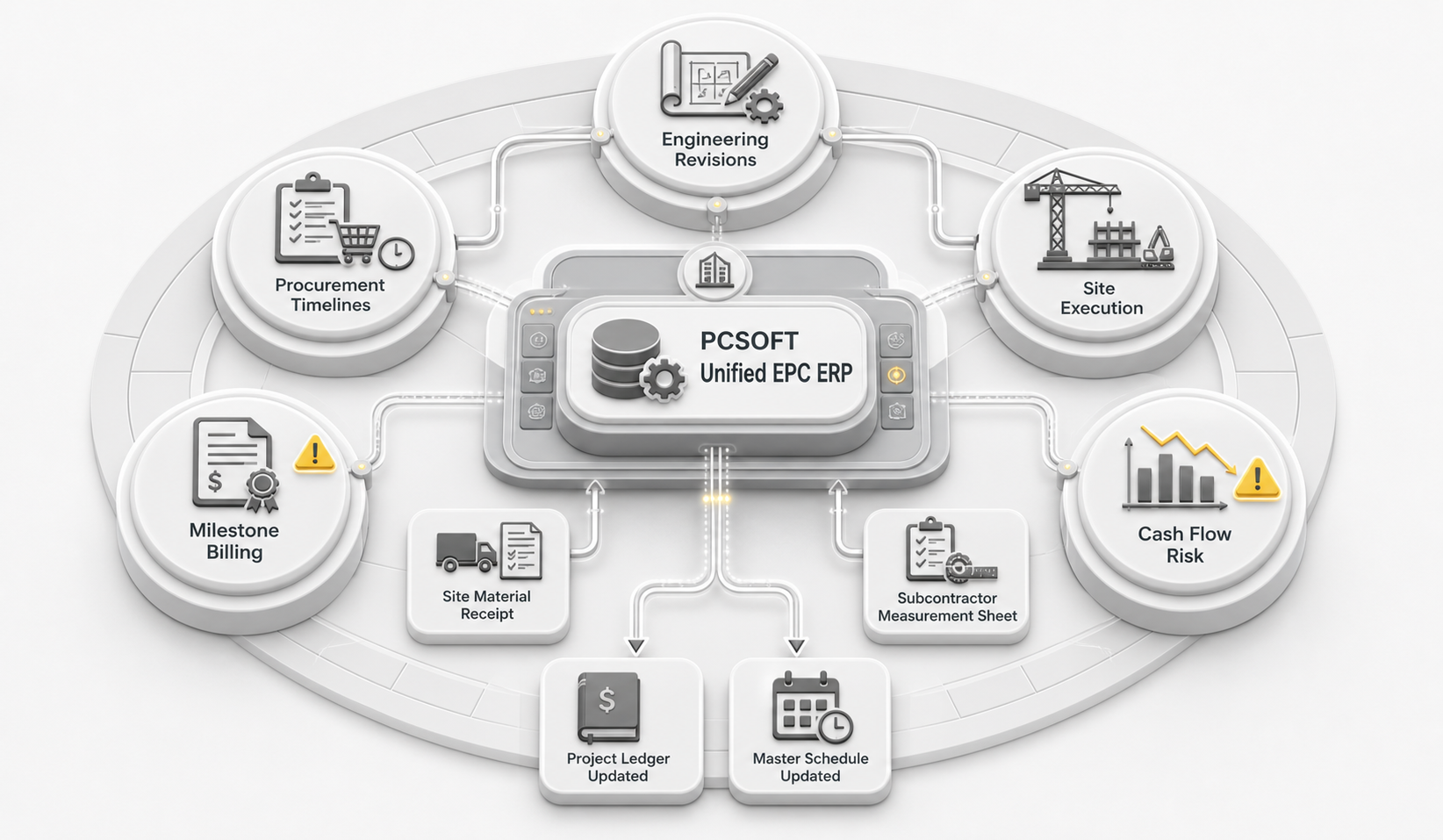
An EPC project cannot operate efficiently when departments run on siloed data. Engineering revisions alter material specifications. Material specifications shift procurement timelines. Procurement delays push site construction schedules. Site delays defer milestone billing, and deferred billing squeezes corporate cash flow directly. Each function feels stable in isolation while the project as a whole quietly falls behind. PCSOFT closes this chain by running every transaction on a unified engineering procurement and construction ERP. A site material receipt, a subcontractor measurement sheet, or an engineering revision updates the project ledger and master schedule the moment it happens, not at the next reporting cycle. Manual data replication between engineering, procurement, site, and finance is eliminated, along with the dispute cycles with clients and subcontractors that usually follow it. Risk becomes visible while it’s still manageable, before a milestone is breached rather than after.
AUTOMOTIVE WORKFLOWS
Power Every Stage of Automotive Manufacturing
Project Planning and WBS Governance
Mega infrastructure and capital goods projects fail to meet margin targets not because teams lack dedication, but because corporate planning models operate completely isolated from real-time floor and site transactions. When a project budget is trapped in an offline spreadsheet or a generic scheduling tool, unauthorized material consumption, equipment idle hours, and budget overruns are only discovered during late-stage financial audits.
PCSOFT establishes absolute financial governance over your projects. Every single resource request, material issuance, or purchase order must validate against a predefined node in the live Work Breakdown Structure and the approved project budget.
Machine-Level Capacity Loading Across CNC Turning, VMC, HMC, and Grinding Resources
Work Order Scheduling Based on Routing, Operation Sequence, and Machine Availability
Priority Management, Rush Job Insertion, and Schedule Rebalancing Without Disruption
Subcontracting Dependency Tracking Linked to Internal Production Schedules
Capacity Utilization Analysis, Overload Identification, and Bottleneck Resolution
Delivery Commitment Tracking Against Live Production Status
Contract, Variation, and Subcontractor Control
Subcontracted labor and specialty execution represent the highest risk variables in modern EPC projects. Managing multiple vendor measurement sheets, applying accurate retention clauses, deducting material usage penalties, and negotiating unapproved client variations through manual paperwork leads to expensive billing leaks and contentious legal disputes.
PCSOFT automates your entire contract administration pipeline. Vendor work orders are directly linked to the core estimate, while site measurement books are captured digitally against live milestones. Unapproved scope changes are automatically flagged as non-billable variances until the client formally signs off on a contract amendment.
Comprehensive Subcontract Work Order Lifecycle with Custom Retention and Escalation Clauses
Digital Joint Measurement Books (JMB) for Site-Level Verification and Transparent Milestone Approvals
Automated Debit Note Calculation for Supplier Materials Used by Subcontractors
Client Variation Order Workflows to Lock and Track Out-of-Scope Revenue Opportunities
Automated Mobilization Advance Tracking, Recovery Mapping, and Bank Guarantee Compliance
Progressive Subcontractor Invoice Matching with Triple-Way Ledger Verification
Project-Centric Supply Chain and BOQ Control
In project manufacturing and infrastructure development, materials cannot sit idly in inventory, nor can they be purchased speculatively. Buying bulk steel, cement, or critical equipment without exact alignment to a WBS node or drawing revision results in massive cash-flow lockups, site inventory deterioration, and untracked material waste.
PCSOFT treats your supply chain as a direct extension of your project schedule. Material Requirements Planning (MRP) calculations are entirely driven by the project’s technical Bill of Quantities (BOQ) and live drawing releases.
Direct BOM and BOQ Import Framework Supporting Engineering and Structural Designs
Project-Identified Material Tracking to Prevent On-Site Resource Hoarding
Automated Request for Quote (RFQ) Portals for Fast Vendor Comparison and Bid Tabulation
Inspection and Logistics Tracking for High-Value, Long-Lead Equipment Assemblies
Site Material Receipt Note (MRN) Registration Tied Directly to Specific Work Nodes
Physical vs. Theoretical Material Consumption Variance Analysis Per Project Section
Plant, Machinery, and Asset Optimization
The profitability of heavy fabrication and large-scale infrastructure construction is directly tied to the utilization rate of expensive capital equipment, batching plants, and mobile fleets. When site supervisors lock down machinery “just in case” or maintenance schedules are ignored until an on-site asset failure occurs, project timelines break down and overhead costs climb rapidly.
PCSOFT treats every critical machine, fleet vehicle, and crane as a revenue-generating center. The software tracks deployment schedules across different project locations, records exact logbook hours, captures actual fuel consumption, and factors equipment availability directly into your core schedule.
Equipment Allocation Matrix Across Multiple Active Projects and Locations
Digital Logbook Capturing Operating Hours, Breakdown Intervals, and Fuel Utilization
Preventive Asset Maintenance Planning Tied to Actual Machine Runtime and Run Cycles
Internal Hire Rate Billing and Transfer Workflows Between Separate Subsidiaries or Cost Centers
Depreciation and Total Cost of Ownership (TCO) Tracking per Capital Construction Asset
Operator Allocation Logs for Performance Monitoring and Labor Cost Redistribution