
Engineering & Machining
Track routing progress, machine utilisation, tooling activity, and work-in-progress across precision machining and engineering environments. Improve capacity planning, resource utilisation, job costing, and operational efficiency while maintaining complete visibility across all shop floor operations.
INDUSTRY CAPABILITIES
Built Around Core Engineering & Machining Operations
Production Planning & Capacity Management
A job scheduled without checking actual machine capacity is a delivery promise made on hope. Schedule jobs across CNC turning centres, VMCs, HMCs, grinding machines, and fabrication cells based on real machine capacity, material availability, and delivery commitments. Planners see what's actually free before committing a date, not after the shop floor pushes back.
Routing & Work Order Control
A job that's "somewhere in production" is a job nobody can give an honest status update on. Track every operation across the manufacturing routing sequence with real-time visibility into job progress, work centre status, operation completion, and bottleneck identification. Delays get spotted at the operation where they're happening, not discovered at final inspection.
Machine Utilisation & Tooling
Idle machine time and untracked tool wear are invisible costs that only show up as missed capacity later. Monitor machine loading, spindle utilisation, setup times, tool consumption, and tool life across every machining resource. Underused capacity and approaching tool-change points are visible before they cause a bottleneck or a mid-job breakdown.
Job Costing & Profitability
A job can look profitable on the quote and still lose money once machine time, tooling, and subcontracting are accounted for. Capture material consumption, machine time, labour costs, tooling expenses, and subcontracting charges against every job. True manufacturing cost and margin are known job by job, not estimated after the invoice is raised.
Quality & Inspection Management
A non-conformance caught at final inspection is far more expensive than one caught at first-off. Manage first-off inspections, in-process checks, final inspections, non-conformance reporting, and corrective actions with full traceability throughout production. Every quality event is tied to the job and operation where it occurred, not logged separately after the fact.
Work-in-Progress Visibility
Jobs that stall between work centres are the hardest delays to catch until a delivery date is already at risk. Track jobs across every routing stage, work centre queue, and subcontracting activity, identifying delays and deviations as they happen. Production teams intervene before a schedule slip becomes a missed delivery, not after.
PROCESS INTEGRATION
Control Every Stage of Engineering Manufacturing
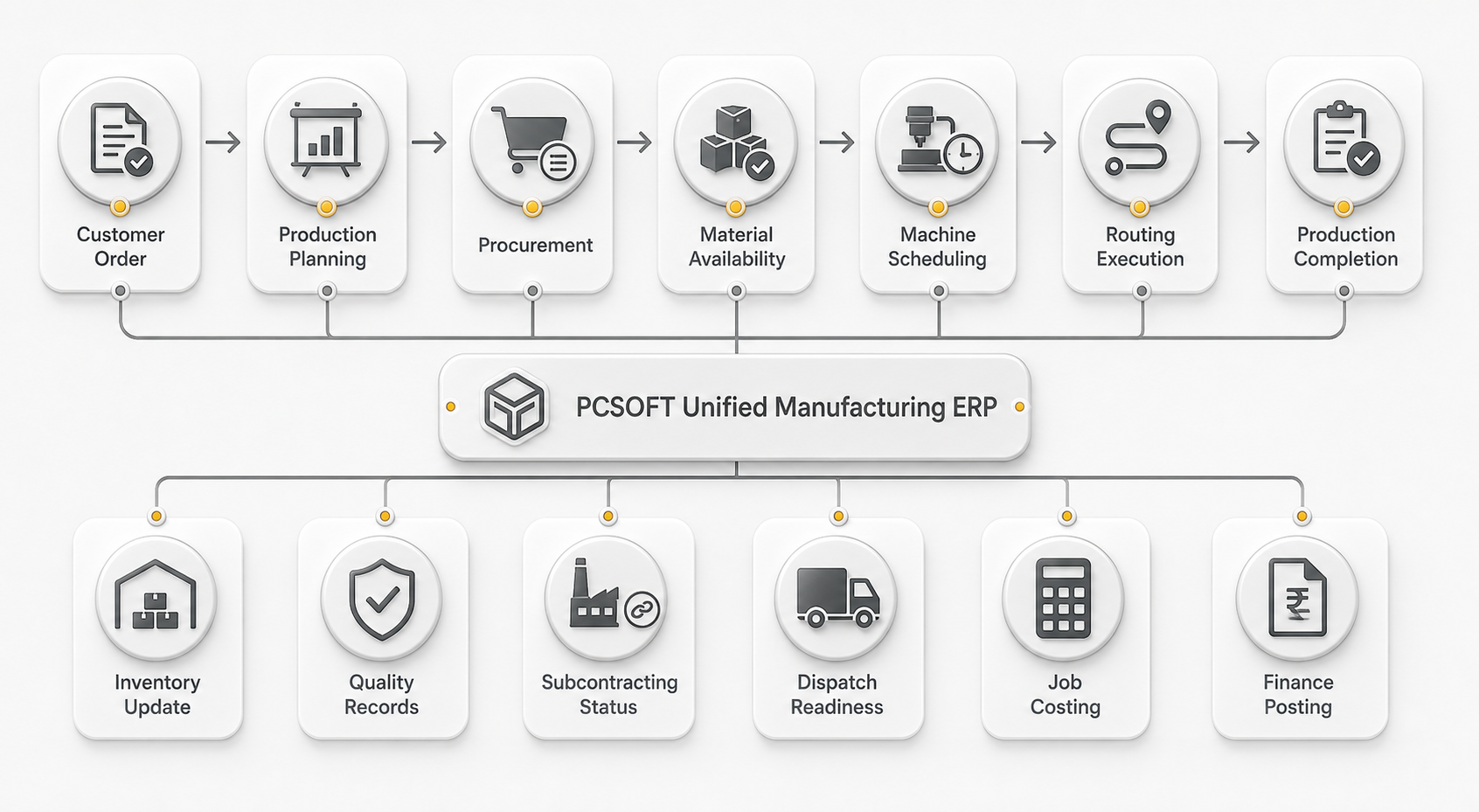
Engineering and machining operations do not function in isolation. A customer order drives production planning, and planning determines material procurement. Material availability dictates machine schedules, which in turn drive routing execution. Finally, production completion updates inventory, quality, subcontracting, dispatch, costing, and finance. By connecting every transaction through a unified manufacturing ERP system, PCSOFT ensures production teams, planners, and management always work from the exact same real-time information. This eliminates manual coordination, reduces data entry errors, and enables faster operational decisions across the organization.
AUTOMOTIVE WORKFLOWS
Power Every Stage of Automotive Manufacturing
Intelligent Capacity Planning
Machine shops often lose delivery performance not because they lack orders, but because planning happens without clear visibility into what is actually available on the shop floor. A VMC already loaded at 90 percent, a tool being regrinded, or a subcontractor running late on a critical operation will not show up in a spreadsheet plan until the damage is done.
As a comprehensive engineering erp software, PCSOFT schedules production against real floor constraints. Machine availability, routing requirements, tooling readiness, operator allocation, subcontracting timelines, and customer delivery commitments are all visible from a single planning environment. Planners can load, rebalance, and reprioritize schedules instantly without rebuilding the entire plan from scratch when priorities shift.
Machine-Wise Capacity Loading Across CNC Turning, VMC, HMC, and Grinding Resources
Work Order Scheduling Based on Routing, Operation Sequence, and Machine Availability
Priority Management, Rush Job Insertion, and Schedule Rebalancing Without Disruption
Subcontracting Dependency Tracking Linked to Internal Production Schedules
Capacity Utilization Analysis, Overload Identification, and Bottleneck Resolution
Delivery Commitment Tracking Against Live Production Status
Routing Execution and WIP Control
Once a job is released to the shop floor, it enters the most unpredictable part of production. It moves between machines, waits in queues, gets interrupted by urgent jobs, goes to a subcontractor, comes back, and moves to inspection. Somewhere in that journey, the customer calls asking for an update that nobody can answer confidently.
Our production ERP software tracks every job at every operation across every work center. Queue times, operation completion, subcontracting status, rework loops, and WIP movement are all visible in real time. Production supervisors know exactly where every job is without walking the floor or chasing operators for updates.
Operation-Wise Job Tracking Across Every Work Center from Release to Completion
Real-Time WIP Visibility Including Queue Times, Idle Operations, and Routing Deviations
Shop Floor Booking Against Each Operation, Machine, and Shift
Subcontracting Job Status Linked to Internal Routing Progress
Rework and Rejection Loops Captured Against Specific Operations and Materials
Production Completion Confirmation Triggering Inventory, Quality, and Costing Updates
Tooling and Machine Performance
A machine that is physically present but waiting for a tool, a setup that takes two hours instead of forty minutes, or a spindle running at reduced feed because nobody flagged tool wear represents the silent capacity losses that erode profitability. These issues never appear on a basic production report, but they show up every month in low machine utilization numbers and missed deliveries.
PCSOFT brings tooling and machine performance into the same operational environment as production planning. Tool issuance is linked directly to the job, tool life is tracked against actual usage, and maintenance is planned around production loading rather than after a breakdown occurs. Every capacity loss is recorded, visible, and attributable.
Tool Issue and Return Linked to Specific Jobs, Operations, and Work Orders
Tool Life Monitoring Against Actual Runtime, Shot Count, and Regrinding Cycles
Tool Crib Management, Critical Tool Availability, and Pre-Job Tooling Verification
Machine-Wise Utilization, Idle Time, Setup Time, and Breakdown Tracking
Preventive Maintenance Scheduling Planned Around Production Loading
Downtime Analysis by Machine, Reason, and Shift for Operational Improvement
Quality Built Into Production
In precision manufacturing, quality cannot be an afterthought inspected only at the end of a run. A dimensional error found at the first operation costs minutes to correct. The same error found at final inspection, or worse, at customer goods inward, costs days of lead time, heavy rework expenses, and customer confidence that takes months to rebuild.
This specialized erp software for manufacturing industry compliance embeds quality checkpoints directly into the live routing. First-off approvals gate production release, while in-process checks are linked to specific operations. Non-conformances are raised instantly against the job, material, and operation that caused them. Every quality event is traceable back to its source, supporting the rigorous compliance and audit readiness that engineering customers demand.
First Article Inspection Approval Linked to Work Order Release Control
In-Process Quality Checks Mapped to Specific Routing Operations
Non-Conformance Reporting Against Job, Operation, Machine, and Material
Rework Authorization, Corrective Action Tracking, and Resolution Management
Final Inspection Clearance Controlling Dispatch and Finished Goods Transfer
Quality History Visibility by Part, Customer, Operation, and Time Period
Job Costing and Margin Control
Most engineering businesses know their total revenue, but very few know their actual job profitability. Material costs are estimated at quotation, machine time is approximated, subcontracting charges are booked separately, and rework costs are absorbed without being attributed to the job that caused them. By the time the month closes, the financial numbers do not match expectations and no one can explain the variance.
As an all-in-one erp business management software, PCSOFT captures every cost element as it happens. It records material issued to a job, machine time booked against an operation, labor recorded at each work center, and subcontracting invoices matched to job-specific purchase orders. It also flags rework costs separately from standard production. The result is a precise cost structure that follows every job from release to closure, giving management a clear picture of which customers, jobs, and operations are genuinely profitable.
Material Cost Captured at Point of Issue Against Each Job and Operation
Machine Hour Costing Booked Against Actual Runtime Per Work Center
Labor Cost Allocation Against Specific Operations, Shifts and Operators
Subcontracting Cost Linked to Job-Specific Purchase Orders and Receipts
Rework and Rejection Costs Captured Separately for Accurate Job Profitability
Actual vs Estimated Cost Comparison, Margin Analysis, and Quotation Accuracy Reporting