
Casting & Foundry
Manage heat number traceability, melt planning, production scheduling, pattern management, scrap analysis, and foundry costing through a manufacturing platform built for foundry operations.
Engineered for the Pour. Built for the Bottom Line.
Every pour is a decision that can’t be undone. Alloy composition has to be right, melt scheduling has to hold, and yield loss at the crucible stage compounds straight through to your margin. Foundries can’t run melt shops, pattern shops, and finishing lines on software that don’t talk to each other.
PCSOFT is foundry management software built for the realities of the casting floor. As foundry ERP software covering sand casting, die casting, and investment casting operations, it connects melt planning, alloy composition tracking, heat and batch traceability, core and pattern shop scheduling, casting yield analysis, and scrap and rejection reporting with procurement, inventory, and dispatch. Heat numbers carry forward automatically from pour to finished casting, so foundry quality management stays traceable without a parallel paper trail.
For foundries evaluating casting ERP software, comparing foundry production planning software, or shortlisting ERP software companies in India, PCSOFT delivers a customised ERP software configuration built around melt-to-dispatch operations, not adapted from a generic manufacturing template. It’s foundry cost accounting software and ERP business management software engineered for yield-critical output, energy consumption tracking per pour, and the delivery discipline foundry customers expect, consistently ranked among the best ERP software for manufacturing in India.
INDUSTRY CAPABILITIES
High-Fidelity Control Over Complex Thermal Workflows
Melt Optimization & Charge Control
Charge mix decisions made by feel cost money on every heat. Balance scrap, ferroalloys, and returns using linear calculation models built to hit chemistry specification while minimising material cost per heat. Get the charge right before the furnace lights, not after the chemistry lab flags a miss. Every charge calculation is logged against the heat it was used for, so cost variance by alloy grade becomes visible instead of buried in month-end material consumption reports. Foundries running high alloy volumes see the difference directly in scrap rate and metal cost per tonne poured.
Pattern & Core Box Lifecycle
Tooling wears out long before anyone notices on the shop floor. Track cumulative pour counts, wear degradation, repair history, and storage location for every pattern and core box in use. Catch tooling-related defects before they show up as scrap, and stop unscheduled downtime before it stops the line. Repair and replacement cycles get scheduled against actual usage data rather than a maintenance calendar that assumes every tool wears the same way. Pattern shop teams work from a live inventory instead of a memory of where things were last stored.
Multi-Level Heat Traceability
A defect discovered downstream is only useful if you can trace it back. Link every raw material heat directly to its poured castings, chemistry logs, non-destructive testing reports, and the specific customer shipment it went into. When a customer raises a quality query, the full heat history is one lookup away, not a warehouse search. Traceability holds across every stage the casting passes through, from melt to machining to final dispatch, with no manual re-entry breaking the chain. For foundries supplying automotive or aerospace-grade castings, this level of heat-to-shipment traceability isn't optional, it's the audit trail customers expect to see on demand.
Sand System & Additive Monitoring
Molding quality is decided in the sand, not just the pour. Log green sand properties, moisture content, permeability, and additive ratios continuously to keep every molding line within technical tolerance. Sand system drift gets caught before it becomes a casting defect, not after. Trend data across shifts makes it possible to spot a sand system degrading gradually, long before it produces a batch of rejects. Molding line consistency stops depending on one experienced operator's judgment and becomes a monitored, repeatable process.
Dynamic Furnace Scheduling
Furnace idle time and thermal loss are margin leaving the building. Sequence pours by alloy family, furnace capacity, holding time, and molding line readiness to cut energy waste and keep throughput predictable. Scheduling becomes a system decision, not a shift supervisor's best guess. Alloy family grouping reduces the number of furnace changeovers per shift, which is where a large share of avoidable energy cost actually comes from. Production planners get a live view of furnace-to-molding-line readiness instead of coordinating pours over radio calls and shop floor walkthroughs.
Integrated Quality & Defect Tracking
Scrap reduction starts with knowing exactly where defects originate. Capture metallurgy checks, spectrographic data, x-ray results, and physical casting defects directly on the shop floor as they happen. Defect patterns become visible by alloy, by furnace, by shift, turning scrap reduction into a data problem you can actually solve. Recurring defect types get flagged automatically once volume crosses a defined threshold, prompting review before the pattern becomes a costly trend. Quality data stays linked to the same heat and pour records used for traceability, so root cause investigation starts with evidence instead of speculation.
PROCESS INTEGRATION
Connect the Entire Foundry Flow
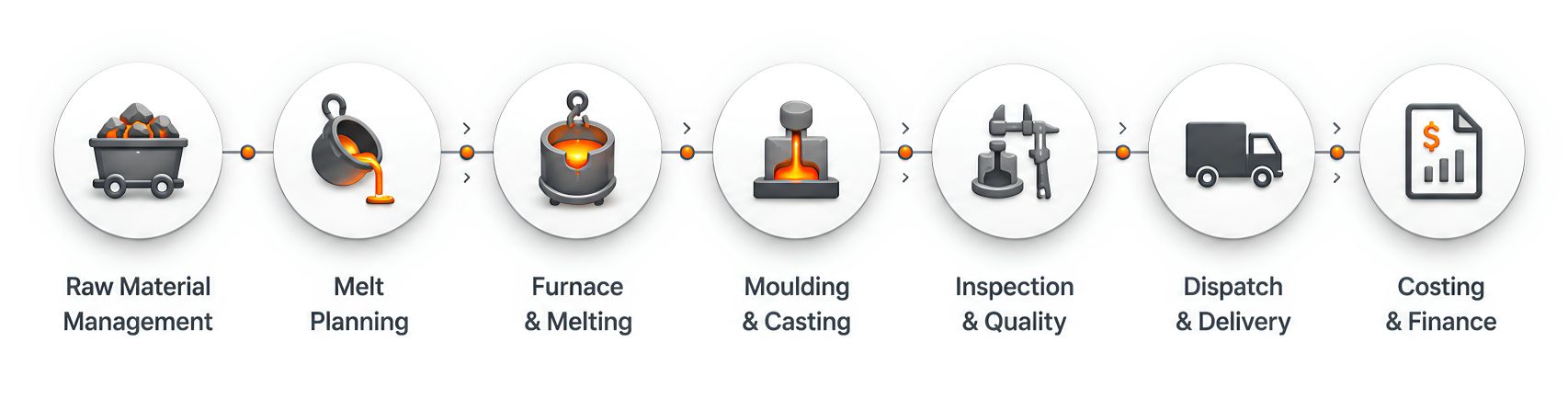
Foundry operations do not happen in isolation. Customer demand drives production schedules. Production schedules influence melt planning. Melt planning impacts material requirements. Production activity updates quality, dispatch, costing, and financial reporting. When these stages run on disconnected systems, every handoff becomes a delay. A change in delivery date should shift the melt schedule within minutes, not after someone manually walks the update across departments. A quality rejection should immediately reflect in dispatch planning and cost of goods, not surface weeks later during reconciliation. PCSOFT connects every stage into one operational sequence. Raw material receipt updates inventory and melt planning in real time. Furnace data feeds moulding and casting schedules. Inspection results determine what moves to dispatch, with financial impact reflected automatically in costing. Nothing waits for a manual update, and nothing gets entered twice. The result is one connected system instead of departments passing information by phone and paper traveler, with material cost, furnace utilisation, and delivery performance visible end to end.
OPERATIONAL DEEP-DIVE
Powering Every Stage of Casting & Fettling
Melt Shop Optimization & Chemistry Management
Melt operations demand precise chemical compositions, exact charge-mix modeling, and rigid temperature governance to ensure casting integrity. PCSOFT enables metallurgists to input spectrographic analysis directly into the system, dynamically adjusting ferroalloy additions and tracking chemistry changes across every single tap. By operationalizing these variables, the system bridges the gap between floor metallurgy and commercial procurement, ensuring that raw material inputs match metallurgical demands without introducing margin-eroding material surpluses.
Heat-sheet digital generation, real-time chemistry verification, and spectrograph system data pairing.
Linear charge-mix optimization algorithms utilizing raw scrap, return scrap, and expensive master alloys.
Furnace energy management tracking, tap-to-tap cycle times, and structural refractory lining logs.
Ferroalloy inventory allocation, automated material consumption tracking, and material cost capture.
Slag analysis logging, bath temperature capture, and physical pouring temperature compliance monitoring.
Pouring ladle tracking, holding furnace capacity management, and downstream casting line synchronization.
Pattern Management, Tooling Tracking & Core Production
High-quality castings rely heavily on tight tool tolerances, structural mold strength, and meticulous core placement. The software monitors pattern wear proactively by tracking total impressions, managing core-box availability, and automating maintenance triggers before dimensional tooling drift causes part rejection. This operational control shifts tooling from an unmonitored variable into a highly structured asset lifecycle track, protecting your scrap rates and extending total tooling asset value.
Automated pattern impression counting, cumulative wear profiling, and structural preventive maintenance alarms.
Core room production scheduling, binder chemistry mix ratios, and core shelf-life expiration tracking.
Tooling inventory location mapping across active lines, maintenance bays, and storage locations.
Pattern modification tracking, engineering revision logs, and geometric tooling mismatch risk mitigation.
Matchplate configuration matching, gating and riser design documentation attachment, and layout logs.
Subcontracted tooling repair tracking, tooling vendor performance management, and asset cost calculation.
Molding, Pouring, Shakeout & Finishing Execution
Tracking a casting from the initial pour through shakeout, shot-blasting, fettling, and final grinding requires multi-stage visibility. The platform captures real-time floor yields, maps scrap generation directly to root causes, and tracks work-in-progress movement through aggressive finishing processes. By maintaining an unbroken digital thread through harsh foundry environments, management can trace exactly how variations in the cooling cycle or labor efficiency translate into physical output yields.
Multi-stage routing tracking covering mold lines, pouring lines, shakeout stations, and grinding benches.
Scrap reason-code capture on the shop floor linked directly to specific heats, molds, or patterns.
Machine integration tracking automatic molding line cycles, down-times, and overall equipment efficiency.
Fettling and finishing shop labor tracking, piece-rate payroll capture, and post-pour processing times.
Heat treatment furnace cycle logging, temperature-over-time graphs, and batch quenching data ties.
Rework order loop tracking for weld repairs, re-blasting cycles, and secondary dimensional grinding.
Advanced Non-Destructive Testing & Certification
Heavy industry customers and OEMs demand zero-defect shipments backed by ironclad metallurgical verification records. PCSOFT automates the collection of quality variables across physical, chemical, and non-destructive testing stages, generating compliant Material Test Certificates automatically at dispatch. This tight control architecture ensures that no finished shipment leaves the gate without full documentation clearing every technical hurdle.
Complete spectrographic chemistry data archiving tied natively to customer-facing material test sheets.
Non-destructive testing documentation handling covering ultrasonic testing, radiography, and dye penetrants.
Brinell and Rockwell hardness test logging, tensile testing metrics, and microstructural analysis files.
Customer PPAP documentation support, initial sample inspection report handling, and strict audit readiness.
Defect pareto analysis reporting, scrap trend correlation, and corrective action loop tracking.
Digital quality sign-offs at critical manufacturing hold-points before gate-pass shipping clearance.