
Equipment Manufacturing
Manage complex Engineer-to-Order (ETO) specifications, dynamic multi-level Bills of Materials (BOM), shop floor capacity constraints, tracking across serialization lifecycles, and field service operations through high-performance manufacturing ERP software built for industrial machinery and capital equipment manufacturers.
Bridge the Gap Between Engineering Revisions and Shop Floor Execution
A single uncommunicated design revision can ripple through material already committed. A component delayed at the port can silently push out an entire delivery schedule. An untracked change to a customer’s assembly configuration can wipe out margin on a complex capital asset before anyone notices.
PCSOFT is industrial equipment manufacturing software built to unify engineering, procurement, production, and finance into one system. As engineering ERP software and manufacturing ERP software in one platform, it connects CAD and PLM design data directly with real-time floor transactions, material tracking, and financial control, giving equipment manufacturers complete visibility across every assembly bay.
For manufacturers evaluating manufacturing ERP software India or comparing ERP software companies in India, PCSOFT delivers customised ERP software engineered around long-lead procurement, multi-level BOM complexity, and capacity-constrained assembly scheduling, ERP business management software consistently ranked among the best ERP software for manufacturing in India.
INDUSTRY CAPABILITIES
Engineered for Custom Machinery and Heavy Equipment Assembly
Dynamic, Multi-Level BOM Management
A missed revision buried three sub-assembly levels deep doesn't surface on the shop floor, it surfaces on the customer's site. Handle deep, complex Bills of Materials featuring hundreds of sub-assemblies and components, with seamless engineering revision control built in. Every change flows through to production the moment it's approved, not after a manual update catches up.
CAD and PLM System Integration
Manually re-entering engineering data into production systems is where costly transcription errors enter complex equipment builds. Import design structures directly from your engineering tools into the live production ledger, generating work orders automatically and eliminating manual data entry. Design and production stop being two systems that have to be kept in sync by hand.
As-Built Serialization and Lot Traceability
When a fault surfaces in the field two years after delivery, the question is always what exact components went into that specific unit. Track high-value components, structural fabrications, and electronic sub-assemblies using ironclad serial and lot tracking from receiving through to final deployment. Any component issue is traced to the exact unit affected, not an entire production batch.
Capacity-Constrained Floor Scheduling
Scheduling a job without checking real machining and welding capacity is a delivery date set on hope, not data. Balance assembly bays, heavy machining resources, specialised welding cells, and testing technicians against real-time floor constraints and delivery dates. Planners commit to dates the shop floor can actually hit.
Advanced Material Requirements Planning (MRP)
Long-lead components punish manufacturers who plan procurement on static reorder points instead of live configuration demand. Run multi-stage material planning driven by actual configuration requirements to eliminate stockouts on long-lead parts without locking up capital in dead inventory. Procurement stays ahead of engineering, not chasing behind it.
Integrated Field Service and Lifecycle Management
For capital equipment, the relationship doesn't end at delivery, and neither should the data. Manage post-delivery operations including warranty updates, preventive maintenance schedules, component replacement records, and field service dispatches from the same system that built the machine. Every service call starts with full build history already attached.
PROCESS INTEGRATION
Synchronize Engineering, Procurement, and Assembly Workflows
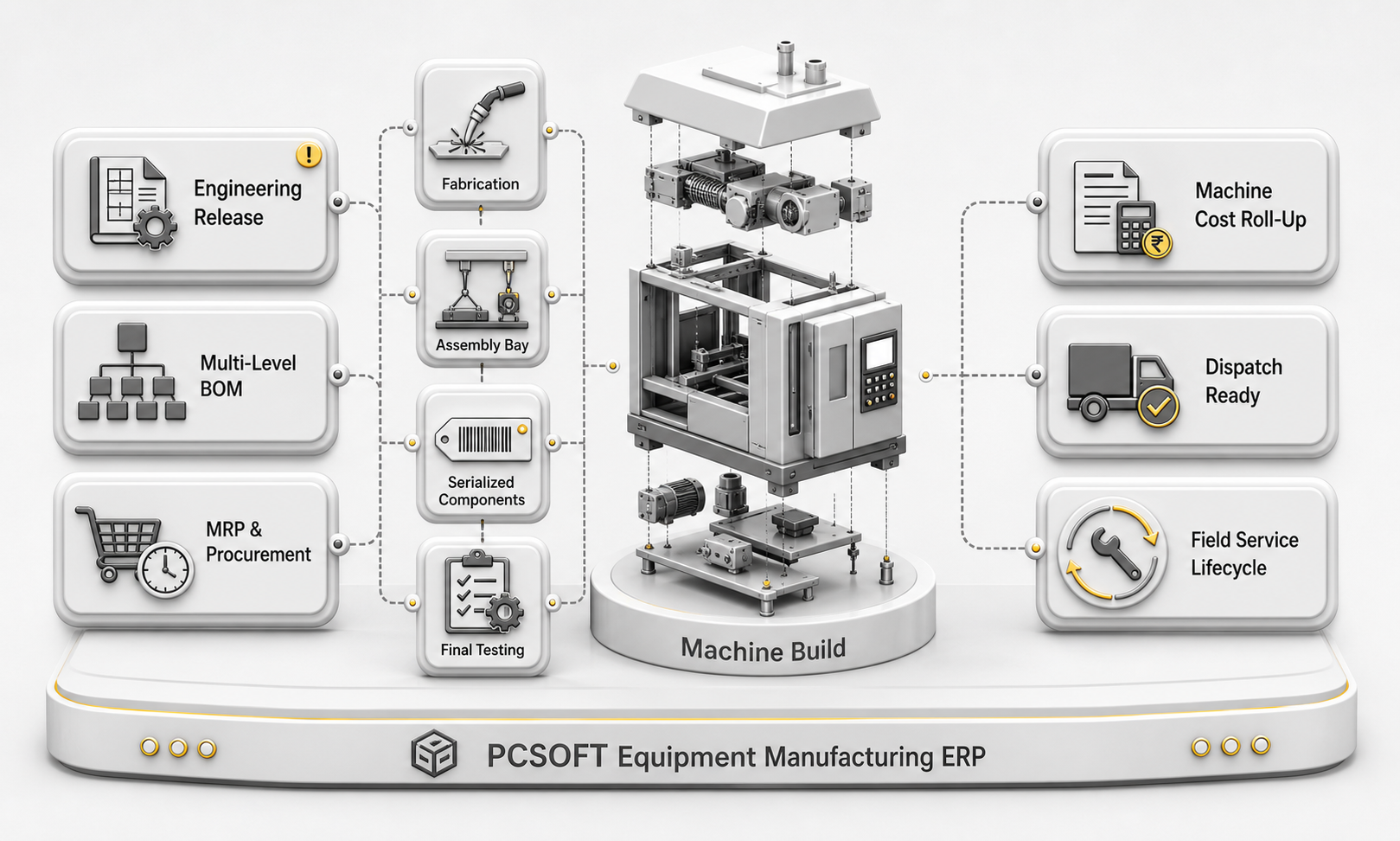
An industrial equipment plant cannot run efficiently when departments work in data silos. An engineering change to a machine layout must instantly update the procurement requirements. Procurement timelines must align directly with assembly bay schedules. A testing delay in the final assembly bay must immediately notify logistics and financial planning. By running your entire production facility on a unified manufacturing ERP system, PCSOFT ensures that every single transaction, whether it is an engineering design release, a component quality gate approval, or an on-site material receipt, updates your operational ledger and schedule instantly. This tight process integration cuts out manual verification loops, prevents the assembly of outdated designs, and gives management real-time cost tracking for every machine built.
EQUIPMENT MANUFACTURING WORKFLOWS
Total Financial and Operational Governance Across the Assembly Floor
Design Integration and Engineering Change Control
Industrial equipment manufacturers lose massive operational velocity when design rooms use software isolated from shop floor production planning. When an engineering change note (ECN) is stuck in an email chain or an unlinked PLM system, workers continue assembling components using outdated drawings, creating expensive scrap metal, unnecessary rework loops, and major scheduling delays.
PCSOFT bridges the gap between engineering design and floor execution. Design files and multi-level Bills of Materials sync directly into the live production ledger, immediately updating active work orders, raw material requisitions, and routing steps when a drawing revision is officially authorized.
Direct CAD and PLM Import Engines to Instantly Build Complex Multi-Level Production BOMs
Automated Engineering Change Note (ECN) Workflows that Hold, Flush, or Update Active Floor Work Orders
Mass Component Substitution Frameworks across Multiple Active Equipment Builds and Designs
Phased Revision Lifecycles (Draft, Approved, Released, Archived) Tied to Material Release Approvals
Side-by-Side BOM Variance Comparisons Pointing out Material, Component, and Engineering Cost Impact
Configurable Item Rules to Handle Minor Variable Engineering Requests without Creating New Part Numbers
Material Requirements Planning and Procurement Control
Managing supply chains for industrial machinery requires juggling long-lead structural castings, custom electronics, and thousands of standardized hardware fasteners simultaneously. Relying on basic reorder points or decoupled spreadsheets leads to sudden shortages in the assembly bay, forcing high-value machinery to sit incomplete while critical delivery dates slip past.
PCSOFT runs precise, project-driven Material Requirements Planning (MRP) calculations. The transaction engine factors in current raw material stock, open purchase orders, live assembly schedules, and exact component lead times to build an optimized procurement calendar that preserves corporate cash flow.
Multi-Echelon MRP Executed across Complex, Deeply Nested Equipment Assemblies
Just-In-Time Component Procurement Schedules Tied to Specific Sub-Assembly Milestones
Automated Material Requisition Approvals Anchored to Live Machine Production Dates
Supplier Delivery Metrics and Quality Inspection Tracking for High-Value, Fabricated Components
Automated Shortage Warning Dashboards Alerting Procurement Teams to Potential Lead-Time Breaches
Direct Landed-Cost Allocation Spreading Freight, Customs, and Handling Expenses into Component Values
Shop Floor Execution and Serialization Traceability
As custom heavy equipment moves through cutting, welding, machining, assembly, and testing, tracking true progress and operational costs becomes incredibly complex. Without a single, localized transaction engine tracking labor time, tool usage, and component assembly, managers cannot spot bottlenecked work centers until a delivery deadline is missed.
PCSOFT tracks floor data down to the exact second and serial number. Workers book hours and material consumption directly against specific work orders, giving supervisors live visibility into every assembly bay while building an ironclad “As-Built” history for every machine shipped.
Operation-Wise Floor Progress Tracking across Fabrication, Sub-Assembly, and Final Acceptance Testing
Complete Forward and Backward Serialization Mapping High-Value Components to Specific Machine Units
Digital Shop Floor Routing Schedules Adjusting for Unexpected Machine Downtime or Tool Shortages
Direct Integration with Smart Shop Devices and PLC Networks for Automated Output Counting
In-Process Quality Inspections and Verification Gates Halting Production when Specs Deviate
Real-Time Work-in-Progress (WIP) Valuation Monitoring Accurately Accumulating Labor and Material Costs
Design Integration and Engineering Change Control
Most equipment builders know their top-line revenue, but struggle to calculate the true financial margin of an individual machine. When engineering revisions, custom floor alterations, and post-delivery warranty support expenses are absorbed into general overheads, management cannot identify which configurations are profitable and which ones are losing money.
PCSOFT tracks and rolls up every single cost element—from the initial raw steel issue to field warranty service calls. The software bridges shop floor execution with post-delivery field asset management, ensuring you maintain a profitable lifetime service relationship with your clients.
Actual vs. Estimated Production Costing Models Isolating Material and Labor Variances
Post-Delivery Installed Asset Matrix Storing Complete Serial History, Drawings, and Service Logs
Warranty Lifecycle Automation Managing Expiration Dates, Claim Invoicing, and Part Replacement
Field Service Dispatch Systems Scheduling Field Engineers based on Skillsets and Part Availability
Preventive and Corrective Maintenance Service Contract Invoicing and Revenue Management
Engineering Redesign Feedback Loops Sending Field Failure Metrics Directly Back to the Design Team